


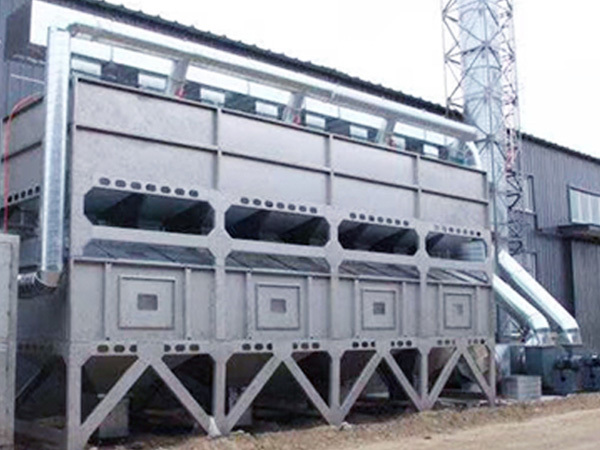
ROC catalytic combustion waste gas treatment equipment
Keywords:
ROC catalytic combustion waste gas treatment equipment
Product Description
Activated Carbon Adsorption Desorption + Catalytic Combustion Device
It is proposed to use a "combination filter + activated carbon adsorption + desorption catalytic combustion regeneration" process to treat your company's organic waste gas. This process uses the heat energy of the catalytic combustion reaction to desorb the organic solvents adsorbed in the activated carbon.
The device includes:
Combination dry filter: 20000m3/hr × 1 unit
Activated carbon adsorption tank: 10000m3/hr × 3 units (2 in operation, 1 standby)
Catalytic combustion device: 3000m3/hr × 1 unit
This device mainly consists of a combination dry filter, activated carbon adsorption tank, electric and pneumatic control valves, catalytic purification device, mixing heat exchanger, VOC online monitoring instrument, flame arrester, centrifugal fan, and electrical control components.
1. Working principle
Based on the principles of safety, energy saving, convenience, reliability, and economy, preventing the waste gas from containing a small amount of dust particles;
First, the organic waste gas is passed through a combination dry filter to remove dust and particulate matter from the waste gas, preventing the micropores of the activated carbon from being blocked and extending the service life of the activated carbon. Then, the organic waste gas that meets the adsorption conditions is sent to the activated carbon adsorption tank for adsorption and purification. The purified clean gas is discharged into the atmosphere by the main exhaust fan. The adsorption device is equipped with a spare adsorption tank. When the activated carbon adsorption is saturated, it is switched to the catalytic combustion desorption state through the control valve; the desorption regeneration system adopts online desorption regeneration, that is, the adsorption process is a continuous process. While the standby adsorption device is put into use, the saturated adsorption tank undergoes desorption, and the desorbed activated carbon tank is prepared for the next cycle. This device is equipped with a VOC online monitoring instrument to prevent exceeding the emission standards during the desorption process and to switch in time.
2. Technical features
(1) The entire system equipment realizes the automation of the purification and desorption process. Compared with the organic waste gas purification device for recovery, it does not require additional energy such as compressed air, the operation process does not produce secondary pollution, and the equipment investment and operating costs are low;
(2) Using specially shaped honeycomb activated carbon as the adsorption material, because its specific gravity is 8-10 times that of bar-shaped activated carbon fiber, the organic solvent adsorbed before regeneration can reach 25% of the total weight of the activated carbon, with a long service life, low operating resistance of the adsorption system, and high purification efficiency;
(3) The equipment has a small footprint and light weight. The adsorption bed filter material adopts a stacking structure, which is easy to fill and replace;
(4) High-quality noble metal palladium and platinum are loaded on honeycomb ceramics as catalysts, which have a long service life, low decomposition temperature, short desorption preheating time, and low energy consumption; the catalytic combustion rate reaches more than 97%;
(5) Using a PLC control system, the operation of the equipment and the operation process are automated, and the operation process is safe, stable, and reliable.
(6) A filter is used to filter small particles before the activated carbon adsorption bed, with high purification efficiency, ensuring the service life of the adsorption device.
3. Process flow diagram
Product Inquiry
If you are interested in our products, please contact us immediately and the company will arrange for a professional to respond to your questions.
Tiansheng Environmental Protection Equipment
Contact Person: Manager Liu
Tel: +86-18663781444
WhatsApp: +86-18660773816
Address: Diaozhen Industrial Park, Zhangqiu District, Jinan City


Copyright © 2023 Jinan Tiansheng Environmental Protection Equipment Co., Ltd.